Policy on Access for People with Disabilities
I. Introduction | II. Policy | III. Disability Coordinator, Services, and Accommodations | IV. Notice that Accommodations are Available | V. Requests for Accommodation | VI. Grievance Procedure | VII. Appeal Procedure | Exhibit A | Exhibit B | Exhibit C | Exhibit D
I. Introduction
The ARDC is committed to providing equal access to all its services, proceedings, and programs (collectively referred to as ARDC activities) for people with disabilities, to ensuring effective communications for people with disabilities who participate in ARDC activities, and to maintaining an environment in which all people, including those with disabilities, are treated with dignity, respect, and courtesy. The Americans with Disabilities Act (ADA), a federal civil rights statute, provides that no qualified individual with a disability shall, on the basis of disability, be excluded from participation in or be denied the benefits of the services, programs, or activities of a public entity, or be subjected to discrimination by any public entity. See 28 C.F.R. 35.130(a). The Illinois Human Rights Act (IHRA) provides that it is a civil rights violation for public officials to deny or refuse to another the full and equal enjoyment of the accommodations, advantages, facilities, or privileges of the official’s office or services or of any property under the official’s care because of unlawful discrimination. See 755 ILCS 5/5-102(C). The ARDC has adopted the following policy and procedures to ensure equal access, reasonable accommodations, auxiliary aids, and services to people with disabilities to participate in ARDC activities that are otherwise open to the general public. For purposes of this policy, “disability” means a physical or mental impairment that substantially limits one or more major life activities. As defined in the ADA and the IHRA, a person with a disability may:
- have an actual disability or
- have a record of a disability or
- be regarded as having a disability.
II. Policy
It is the policy of the ARDC to ensure people with disabilities have full and equal access to participate in ARDC activities and receive accommodations consistent with the requirements of Title II of the ADA and the IHRA. The ARDC will provide free of charge physical access, reasonable accommodations, auxiliary aids and services to ensure effective communication, and reasonable policy modifications to ensure that people with disabilities have an equal opportunity to participate in and benefit from ARDC activities. This policy applies to all members of the public who seek to participate in, observe, or interact with ARDC activities, including lawyers, complainants, witnesses, observers of public proceedings, support workers, care or assistance providers or coordinators, family members, and companions.
Back to TopIII. Disability Coordinator, Services, and Accommodations
The ARDC facilitates participation in ARDC activities through one or more designated disability coordinators and the provision of reasonable accommodations, accessibility aids, and services by engaging stakeholders, service providers, devices, technologies, and physical design elements.
Back to TopA. Disability Coordinator
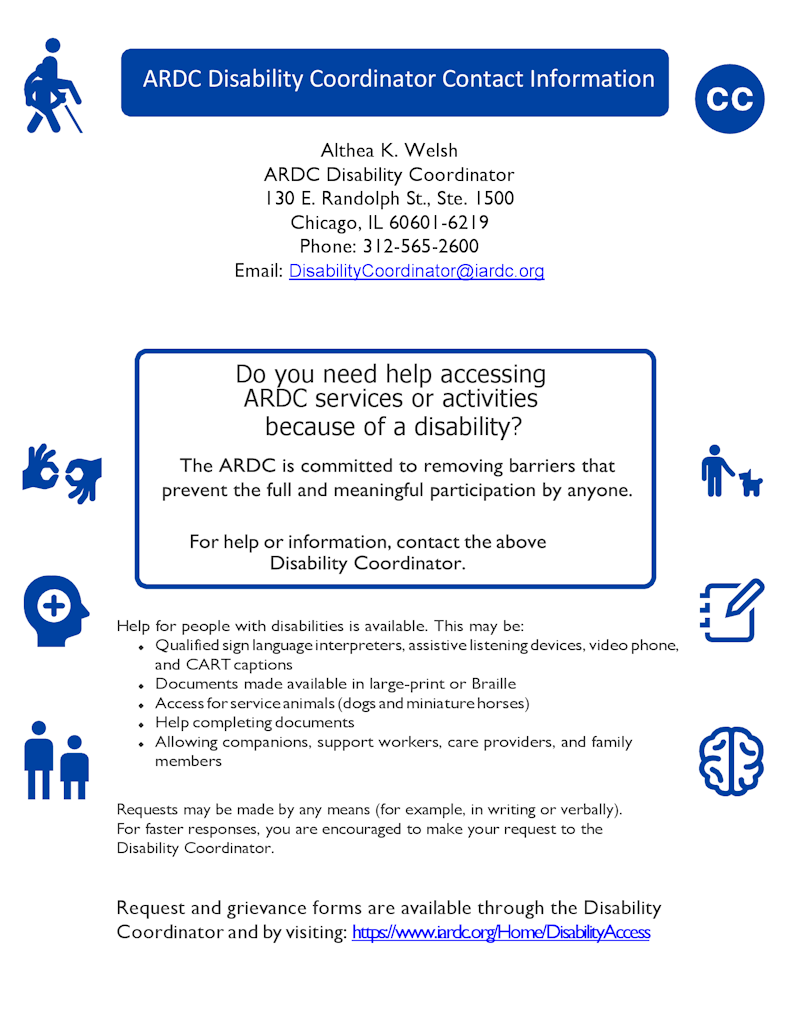
The Administrator will designate one or more ARDC employees to function as disability coordinator(s) to coordinate efforts to comply with and carry out the ARDC’s responsibilities under the ADA, the IHRA, and this policy. See 28 C.F.R. 35.107(a). The ARDC will make available to all interested individuals the name, office address, telephone number, and email address of the employee or employees designated pursuant to this paragraph. See 28 C.F.R. 35.107(a). The name(s) of the disability coordinator(s) and their contact information shall be posted on the ARDC’s intranet and public website. The disability coordinator shall:
- receive and process accommodation requests from and on behalf of people with disabilities pursuant to the procedures outlined in Section V of this policy;
- receive and process grievance requests from people with disabilities pursuant to Section VI of this policy;
- convey accommodation requests for people with disabilities to the appropriate personnel;
- convey only necessary information related to accommodation requests to personnel and take reasonable steps to protect that information from distribution to other individuals; and
- where appropriate, investigate communications alleging noncompliance with or violation of the ADA, IHRA, or this policy by ARDC constituents, or alleging any ARDC actions that the ADA, IHRA, or this policy may prohibit.
B. Reasonable Modification, Auxiliary Aids and Services, Devices, and Technologies to Ensure Equal Access to the ARDC’s Activities
A “reasonable modification” is a modification in policies, practices, or procedures when the modification is necessary to avoid discrimination on the basis of disability and is necessary to accommodate a person with a disability, unless the public entity is able to demonstrate that making the modifications would fundamentally alter the nature of the service, program, or activity or present an undue financial or administrative burden. See 28 C.F.R. 35.130(b)(7)(i). ARDC will furnish appropriate auxiliary aids and services where necessary to afford qualified individuals with disabilities, including applicants, participants, companions, and members of the public, an equal opportunity to participate in, and enjoy the benefits of, its services, programs, or activities. The type of auxiliary aid or service necessary to ensure effective communication will vary in accordance with the method of communication used by the individual; the nature, length, and complexity of the communication involved; and the context in which the communication is taking place. In determining what types of auxiliary aids are necessary, the ARDC gives primary consideration to the requests of individuals with disabilities. In order to be effective, auxiliary aids and services must be provided in accessible formats, in a timely manner, and in such a way as to protect the privacy and independence of the individual with a disability. The ARDC does not require an individual with a disability to bring another individual to interpret for them. Further, the ARDC cannot rely on an adult accompanying an individual with a disability to interpret or facilitate communication except in an emergency involving an imminent threat to the safety or welfare of an individual. The ARDC may, but is not required to, rely on an adult accompanying an individual with a disability to interpret or facilitate communication where the individual with a disability specifically requests that the accompanying adult interpret or facilitate communication, the accompanying adult agrees to provide such assistance, and reliance on that adult for such assistance is appropriate under the circumstances. The ARDC does not rely on a minor child to interpret or facilitate communication, except in an emergency involving an imminent threat to the safety or welfare of an individual or the public, where no interpreter is available. Examples of auxiliary aids and services, devices, and technologies for people with disabilities may include, but are not limited to:
- documents made available in large-print, Braille, or another accessible format for individuals who have visual disabilities;
- access for service animals (dogs and miniature horses) to the ARDC offices;
- adapted proceedings, including extended time for hearings, breaks, and changes of location (including remote or in-person appearances);
- assistance in completing and filing forms and other court documents;
- qualified sign language interpreters, including through Video Remote Interpreting; and
- assistive listening devices, video phones, and Communication Access Real Time Transcription (CART captioning).
C. Physical Access to ARDC Offices
While the ADA requires, at minimum, programmatic access, the ARDC also strives to provide full, feasible physical access to its offices, including:
- routes of entry, entrances, and parking spaces;
- hearing rooms, including witness seating, counsel tables, and spectator areas:
- conference rooms; and
- restrooms, including access for the individual with the disability and any care provider, attendant, or companion.
D. Accessing ARDC Activities Remotely
As remote ARDC activities continue to expand, including, but not limited to, remote hearings, remote access to certain case records, and electronic filing, the ARDC shall consider its obligations under the ADA and IHRA to provide programmatic access to these avenues of utilizing ARDC activities. The ARDC shall ensure that its remotely offered activities are accessible, including meeting website accessibility standards such as the Website Content Accessibility Guidelines (WCAG) and the Section 508 standards, which the federal government uses for its websites, providing support to people with disabilities who are accessing remote ARDC programs and activities, or granting exemptions to mandatory remote programs (for example, exempting people with disabilities from mandatory e-filing requirements when their disability prevents them from e-filing). Further, the ARDC shall consider how remote activities may be necessary to accommodate people with disabilities and allow them to access activities in as integrated a setting as possible. However, the ARDC shall not require a person with disabilities to use any such special or alternate offering. The person with disabilities has the right to choose whether to participate in the standard offering or an alternate option.
Back to TopIV. Notice that Accommodations are Available
The ARDC shall provide notice that accommodations are available to ensure that people with disabilities have equal opportunity to participate in ARDC activities by posting the notice attached as Exhibit A, containing current information, in an accessible location near entryways to its offices and in an accessible format on the ARDC website.
Back to TopV. Requests for Accommodation
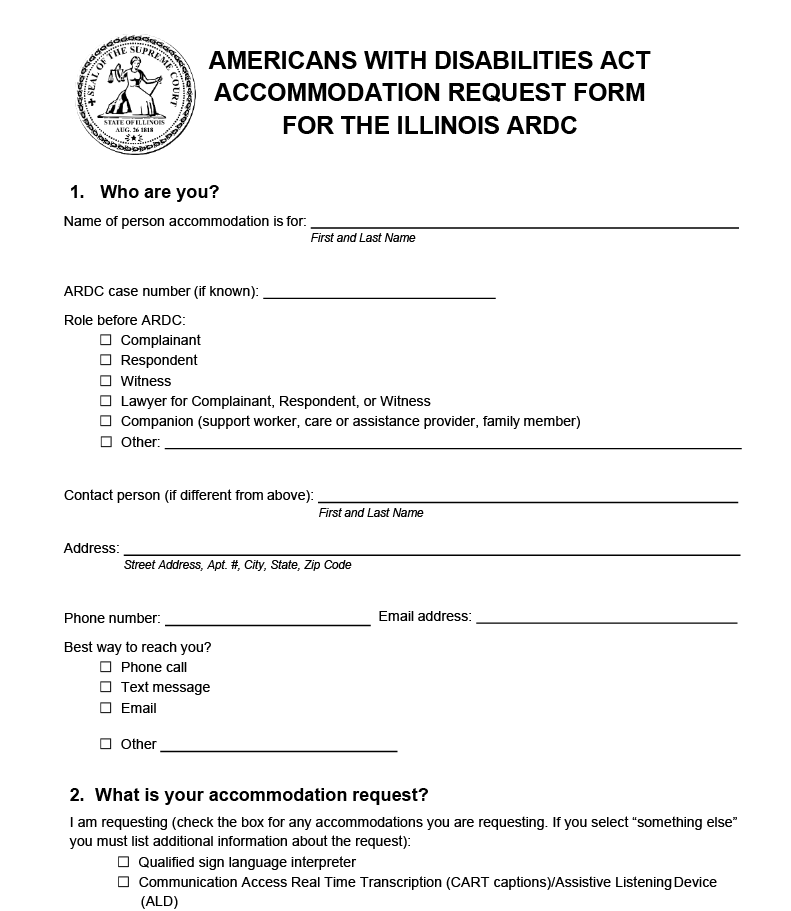
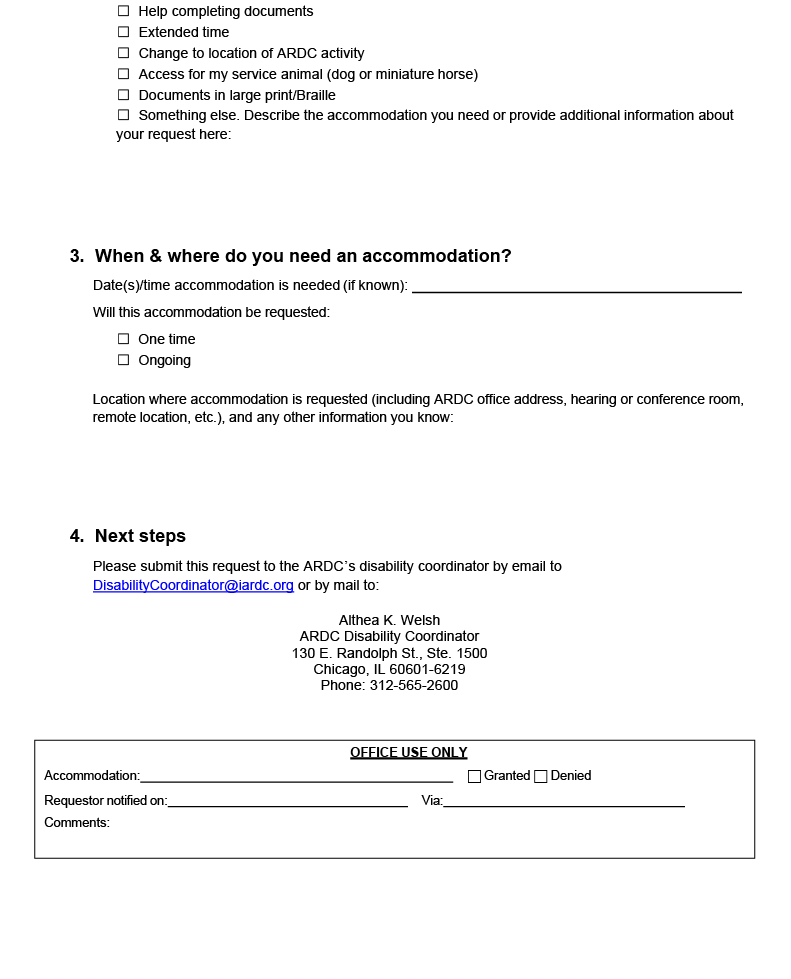
Generally, individuals with disabilities must request accommodation, unless the disability and need for accommodation are obvious (e.g., a blind individual who needs to use their service animal or a deaf individual who cannot communicate verbally). The disability coordinator or a designee shall provide a request form to people requesting services or accommodations for people with disabilities. The request form, attached as Exhibit B shall be available in an accessible format (in a fillable, accessible PDF) on the ARDC website. However, the person making the request may submit it in any form, written, verbal, or other means (including by email or automated submission process), and the ARDC may not require completion of Exhibit B or any other form or format. Whenever possible, a request for accommodation or services should be made ten (10) business days in advance of the ARDC activity. The ARDC shall make reasonable efforts to honor an accommodation request whenever it is received, even if it is not ten (10) business days in advance of the activity. If the ARDC receives an accommodation request that cannot be fulfilled in advance of the activity, the ARDC may continue, extend, or reschedule it in order to accommodate the request. The request should be as specific as possible and include a description of the accommodation sought and the date the accommodation is needed. If the request does not contain enough information, the disability coordinator may ask for additional information. Requests for additional information may be in any form, including written, verbal, or other means, and may only require the information necessary to establish the elements of a reasonable accommodation and that the accommodation is related to the need of the person with the disability. The request should be directed to the disability coordinator. However, any ARDC personnel (i.e., board members and staff) can receive a request and convey it in any format to the disability coordinator. If the request is made in writing to ARDC personnel who are not the disability coordinator, the personnel receiving the request shall mail, email, hand deliver, or otherwise relay the request to the disability coordinators. The disability coordinator shall respond in writing and in a format accessible to the person making the accommodation request within at least seven (7) business days from the date the request was received or sooner as the circumstances dictate. Any response to a reasonable accommodation request shall inform the person making the request of the grievance procedure described below. The disability coordinator shall grant any reasonable accommodation necessary to ensure a person with a disability has access and can fully and equally participate in and benefit from ARDC activities, where the accommodation would not result in a fundamental alteration in the nature of an ARDC activity, or undue financial or administrative burden to the ARDC. With respect to ensuring effective communication, the disability coordinator will give primary consideration to the request of the individual with a disability, meaning that the ARDC will honor the choice of the individual, unless it demonstrates that another equally effective accommodation is available, or that the requested accommodation would result in a fundamental alteration of ARDC activities or undue financial or administrative burdens.
Back to TopVI. Grievance Procedure
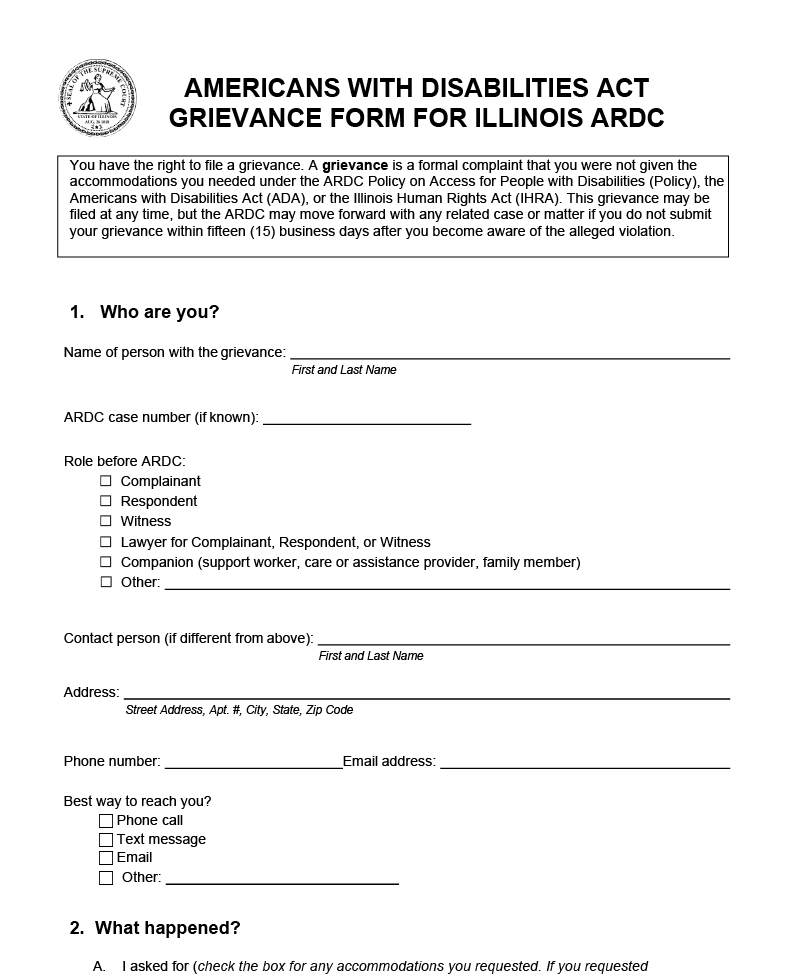
The Grievance Procedure is established to meet the requirements of the Americans with Disabilities Act (ADA). It may be used by anyone who wishes to file a complaint alleging discrimination on the basis of disability in the provision of services, activities, programs, or benefits by the ARDC. A “grievance” is a complaint alleging any action or inaction that violates this policy, the request for accommodations procedure, the ADA, or the IHRA. People have the right to file a grievance when they believe the ARDC and/or its personnel have not complied with the provisions of this policy, the request for accommodations procedure, the ADA, or the IHRA. A grievance may be filed at any time, but to address the issue in a timely fashion, it should be made within fifteen (15) business days after the person filing the grievance becomes aware of the grievance. While the grievance is being resolved, the person may request a stay of proceedings or activities. The grievance procedure is not intended to unreasonably delay ARDC proceedings or processes. The grievance may be in any form, including written, verbal, or other means (including by email or automated submission process) and made to the disability coordinator or a designee. If conveyed in writing or electronically, the person may use the grievance form attached as Exhibit C. The grievance shall contain the name and contact information of the person filing the grievance and briefly describe the alleged violation. Within ten (10) business days after receipt of a grievance, the disability coordinator or a designee may meet with the person submitting the grievance, either in person, by video, or by telephone, in a format accessible to the person submitting the grievance to discuss the complaint and possible resolutions, if the disability coordinator decides such a meeting would be helpful to a determination. Within ten (10) business days after the meeting, or twenty business days after receipt of the grievance if there is no meeting, the disability coordinator shall respond in writing, and in a format accessible to the person submitting the grievance. Any response to a grievance shall inform the person making the grievance of the appeal procedure described below. Independent of the resolution of the grievance procedure, the person submitting the grievance retains the right to pursue legal action for any alleged violations of the ADA and IHRA, and such rights are not dependent on exhausting the grievance, appeal, or other administrative procedure.
Back to TopVII. Appeal Procedure
If the response by the disability coordinator does not resolve the issue to the satisfaction of the person submitting the grievance, the person may file an appeal to the decision after receiving the disability coordinator’s response to the Administrator. To address the issue in a timely fashion, the appeal should be made within fifteen (15) business days of the date of the disability coordinator’s written response. While the appeal is being resolved, the person may request a stay of ARDC proceedings or activities. The appeal procedure is not intended to unreasonably delay ARDC proceedings or processes. The appeal may be in any form, including written, verbal, or other means (including by email or automated submission process). If conveyed in writing or electronically, the person may use the appeal form attached as Exhibit D. Within twenty (20) business days after receipt of the appeal, the Administrator will respond with a final resolution of the grievance procedure in writing and in a format accessible to the person submitting the grievance. Independent of the resolution of the appeal procedure, the person submitting the appeal retains the right to pursue legal action for any alleged violations of the ADA and IHRA, and such rights are not dependent on exhausting the Grievance Procedure. Adopted by the Commission on October 17, 2025. Effective immediately.
Back to TopExhibit A
 Back to Top
Exhibit B
 Back to Top
Exhibit C
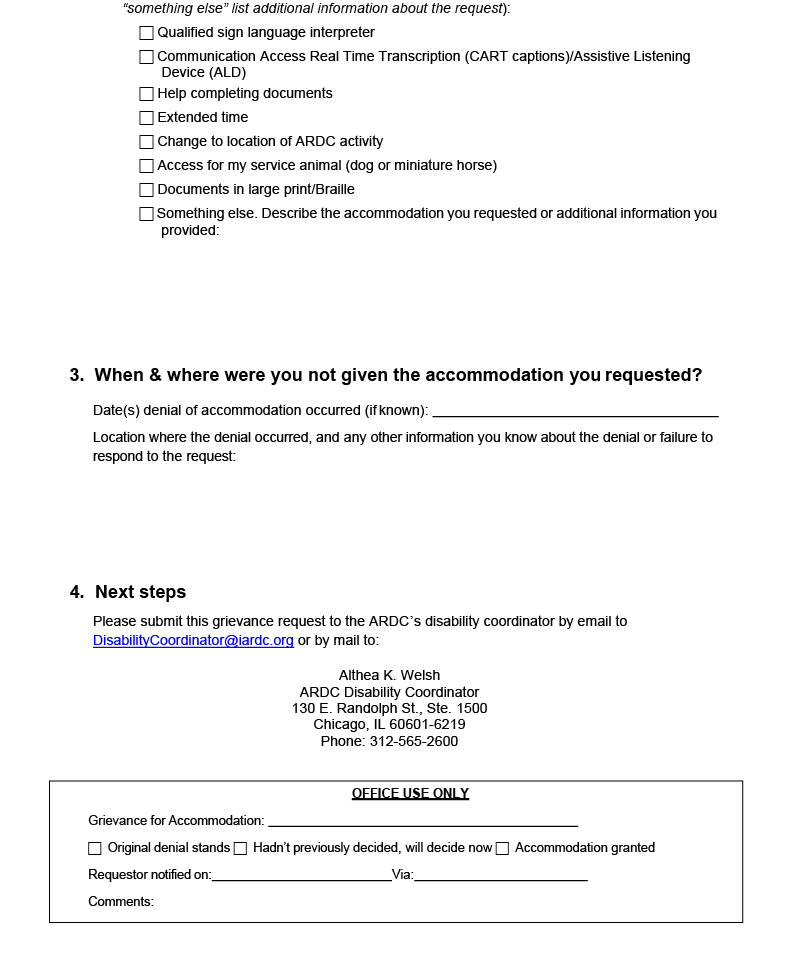 Back to Top
Exhibit D
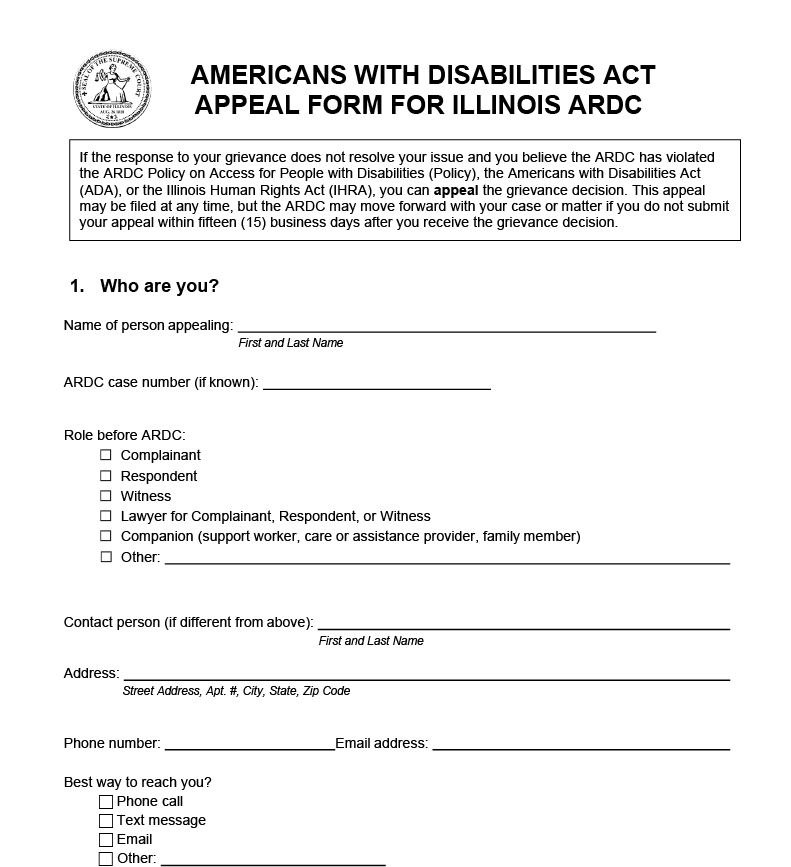
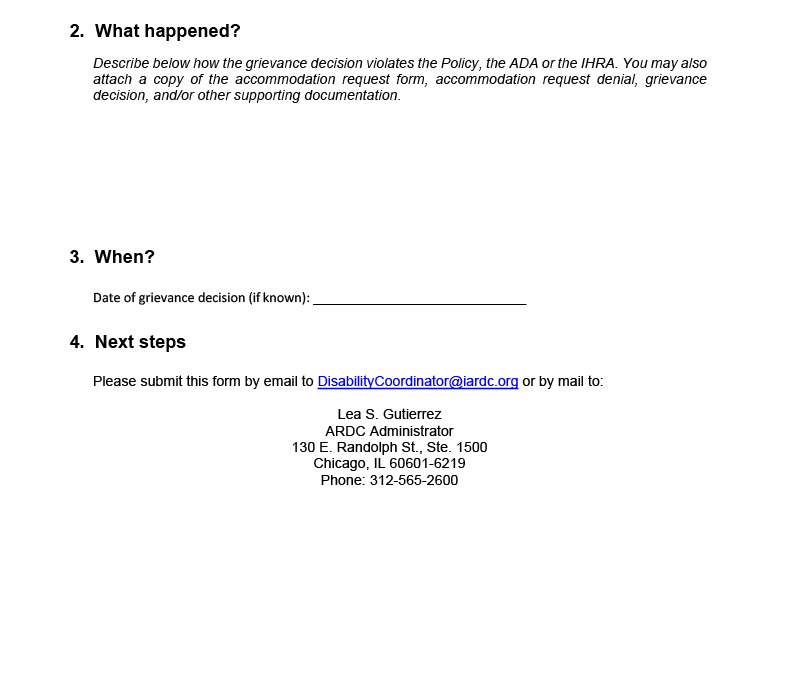 Back to Top